 Decks
不会: Chinese Frequency 5000 flashcard
↑ Back to deck← PreviousNext →Random card
不会
Used other than figuratively or idiomatically: see 不, 會. Used in rhetorical questions to express reproach for nonperformance of an action to be unable to; to have not learned to
bùhuì
Card 69 of 5,214 in Chinese Frequency 5000.
Example sentences
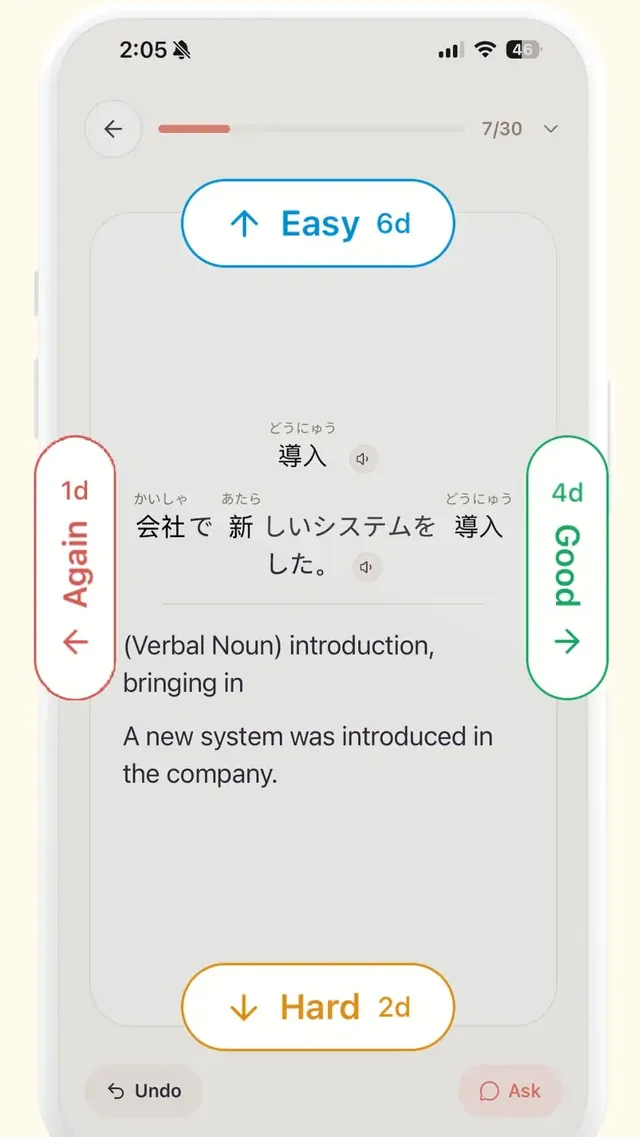
Studying this deck in Decks
After each card you rate it Again, Hard, Good or Easy, and the rating sets when it comes back. Chinese Frequency 5000 has 5,214 cards in the app; this site shows the first 100.
More from Chinese Frequency 5000
着
⁜ to attach Particle indicating the continuation of an action or a state. Often used with 正在 (zhèngzài) or 正 (zhèng). Particle denoting the success or continuation of an action.谁
who; whom someone; anyone anyone; whoever过
to cross; to pass; to go across; to pass through adjectival complement • (chiefly Classical Chinese, Cantonese) indicating an excess in degree or amount; more ... than • indicating that the state has existed in the past verbal complement • indicating passing by; over; by • indicating a change in direction; over; away • indicating an excess in degree or amount; past; through; by • indicating superiority; better than • indicating completion or that an action has occurred already; ever; already告诉
(chiefly Mandarin) to tell; to inform (formal, law) to file a lawsuit against someone为什么
why; for what reason; how come不能
cannot; must not; should not (neologism, slang) A verbal complement expressing incapability. to be unable to; to fail to