 Decks
Flashcards for iPhone with Anki-style spaced repetition
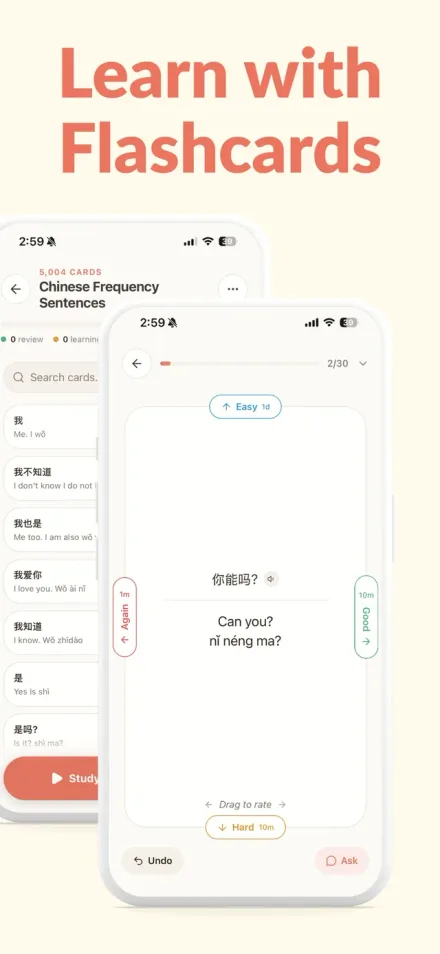
Decks schedules your reviews with SM-2, the algorithm Anki was built on. It comes with 39 free decks for Spanish, Japanese, Chinese, Korean, French and German (82,733 cards, most with native audio), and you can make your own.
What Decks does
- Scheduler
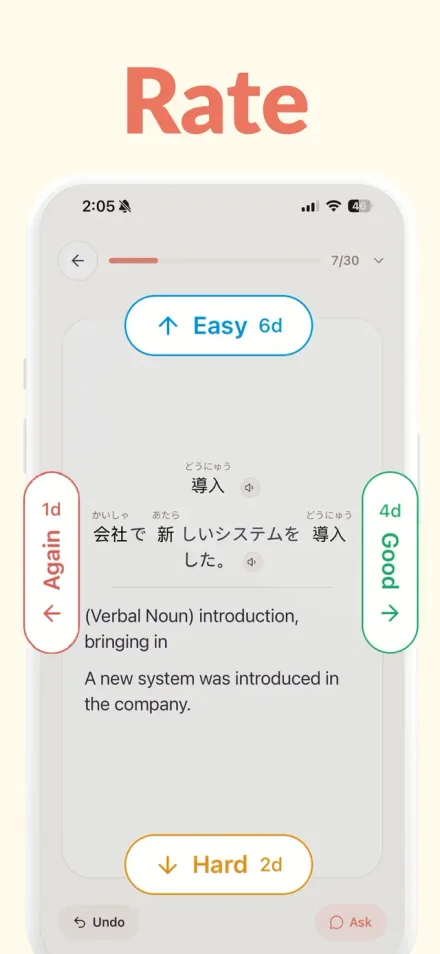
- SM-2, the algorithm Anki was built on. Ratings: Again, Hard, Good, Easy.
- Library
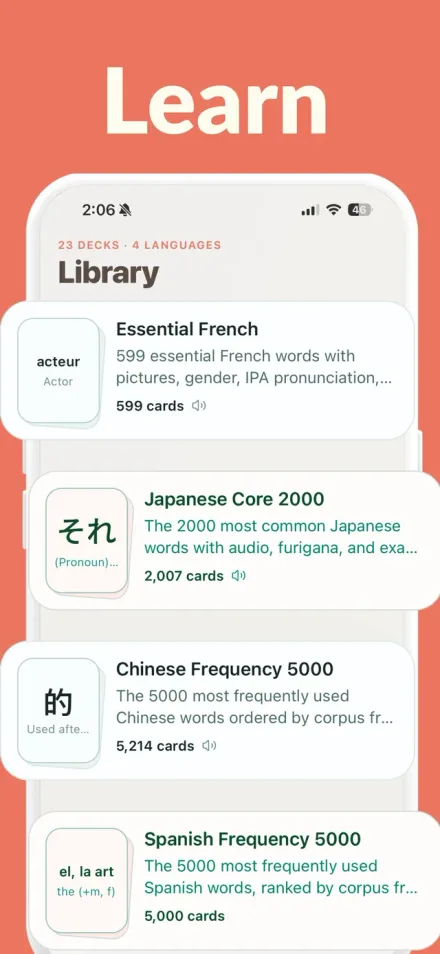
- 39 decks, 82,733 cards: Spanish, Japanese, Chinese, Korean, French, German. Most have native audio.
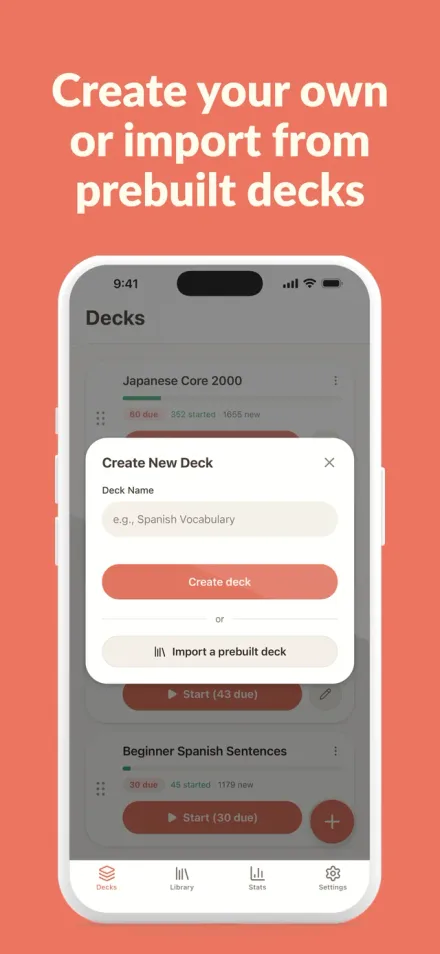
- Your own cards
- Front and back, with bold, furigana and fill-in-the-blank (cloze). Audio and pictures only come with library decks.
- From a photo
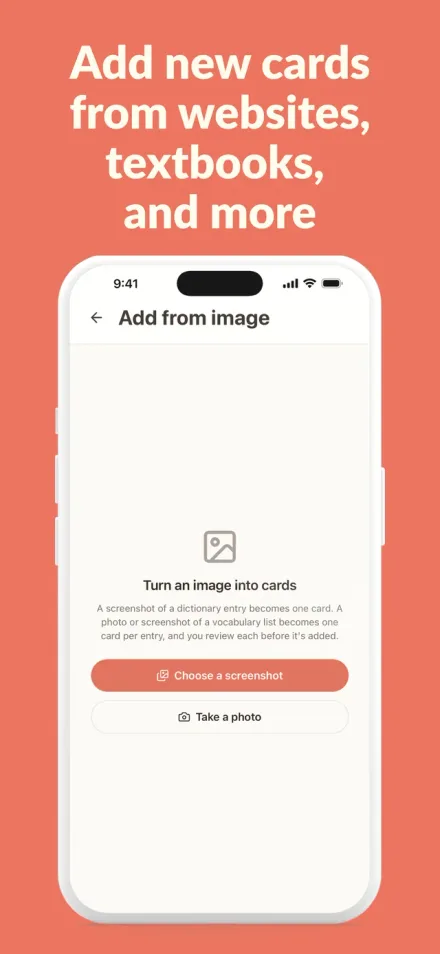
- Photograph a page or screenshot a dictionary entry; AI reads it and proposes cards, which you check before adding.
- Ask
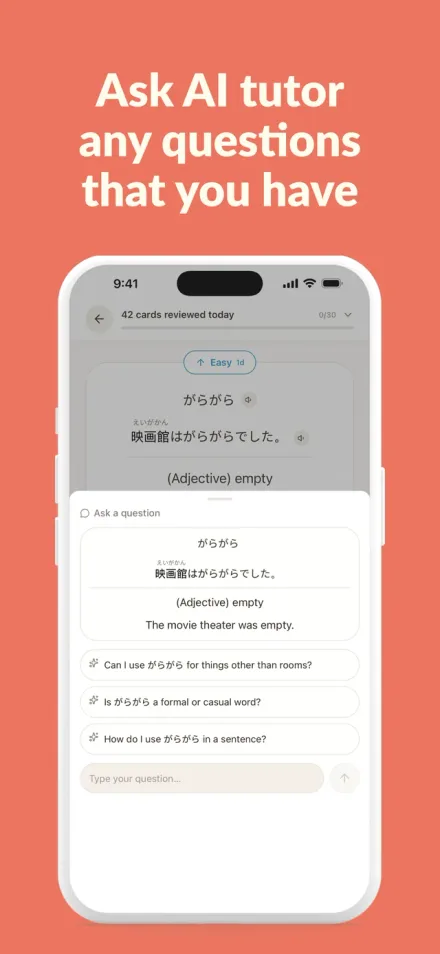
- Type a question about the card you're reviewing and get an AI answer.
- Rating
- Tap, or drag the card toward the rating.
- Daily limits
- New cards per day are yours to set (default 20). The free plan has a daily review limit; Premium lets you set your own.
- Stats
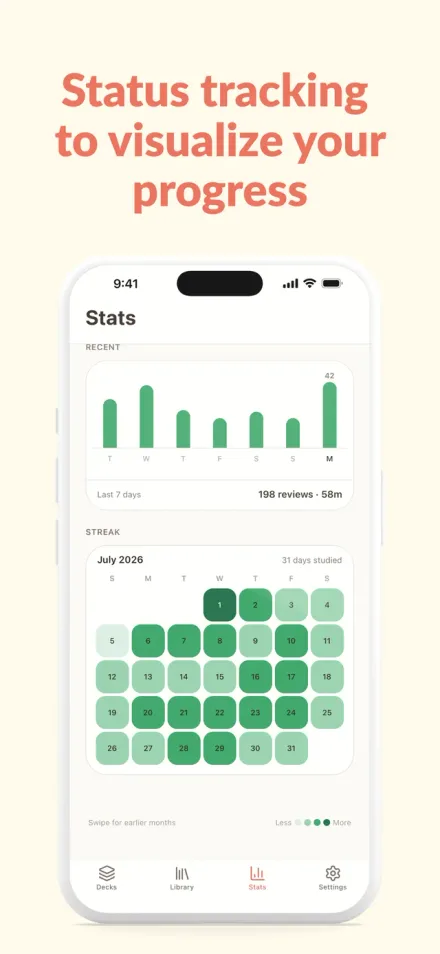
- Reviews per day, retention, and a calendar of study days.
- Offline
- Reviews work without a connection.
- Account
- Optional. You can study without one.
- Doesn't do
- Open .apkg files, add-ons, FSRS, Android, iPad or desktop. The app is in English.
Library decks by language
All 39 decksJapanese flashcards
10 decks · 17,966 cards
- Japanese Hiragana
- Japanese Katakana
- Japanese Core 2000
- Japanese Core 6000
- Tae Kim's Japanese Grammar
- JLPT N5 Vocabulary
- JLPT N4 Vocabulary
- JLPT N3 Vocabulary
- JLPT N2 Vocabulary
- JLPT N1 Vocabulary
Chinese flashcards
9 decks · 15,762 cards
- Essential Chinese
- Chinese Frequency 5000
- Chinese Frequency Sentences
- Chinese Grammar HSK 1
- Chinese Grammar HSK 2
- Chinese Grammar HSK 3
- Chinese Grammar HSK 4
- Chinese Grammar HSK 5
- Chinese Grammar HSK 6
Korean flashcards
6 decks · 12,341 cards
- Hangul
- Korean First 500 Words
- Korean Vocabulary 6500
- Korean Beginner Vocabulary in Dialogues
- Korean Grammar Sentences
- Korean Beginner Sentences
Spanish flashcards
5 decks · 20,526 cards
- Spanish Picture Starter
- Spanish Frequency 5000
- Beginner Spanish Sentences
- Spanish 9000 Sentences
- Spanish Conjugation
French flashcards
4 decks · 4,601 cards
- Essential French
- French Frequency 500
- 501 French Verbs
- French Sentences
German flashcards
5 decks · 11,537 cards
- German A1 Vocabulary
- German A2 Vocabulary
- German B1 Vocabulary
- German Frequency 5000
- German Sentences: Intermediate to Advanced
Screenshots
How spaced repetition works
Each time you remember a card, the gap before you see it again grows. Miss it and it comes back in 10 minutes, then restarts at 1 day.
The research, and exactly what each rating doesOne card, rated Good every time:
- 10 min
- 1 day
- 2 days
- 5 days
- 12 days
- 30 days
- 75 days
Using Anki now? Decks vs Anki, feature by feature. Word lists, kana charts, HSK grammar and how SM-2 schedules cards are in the guides.
Guides
All 48 guides- Again, Hard, Good, Easy in Anki: which to press and what each does to the intervalAgain is a fail; Hard, Good and Easy are passes. What each does to the interval and ease, how learning and relearning steps work, and Anki's interval settings.
- Anki daily limits: new cards per day, maximum reviews and custom studyAnki's New cards/day (default 20) and Maximum reviews/day (default 200): how they interact, review loads for 5 to 50 new cards a day, custom study and the 4am day.
- FSRS in Anki: what it is, how to turn it on, and what desired retention to setWhat FSRS is and how it differs from SM-2, how to turn it on in each Anki app, what desired retention (default 90%) does, and every setting in the FSRS section.
- Bury vs suspend in Anki, and what to do with leech cardsBurying hides an Anki card until the next day; suspending hides it until you undo it. When to use each, what a leech is, and how to fix or reset one.
- Anki shared decks: where to find them, how to import them, and how to pick oneWhere Anki's shared decks are, the well-known language decks, how to import one without the author's progress, and what to check before you study it.
- Is Anki free? What it costs on each deviceAnki is free on computers, Android and the web; AnkiMobile for iPhone is a one-time $24.99. What AnkiHub runs now, its plan prices, and free iPhone options.
- Spaced repetition vs cramming: what the research showsWhy spreading study out beats cramming, from a 317-experiment review and a flashcard study where 90% of people did better with spacing.
- Do flashcards work for language learning?What flashcards are good at in language learning (vocabulary, scripts, set phrases), what they can't do, and how to combine them with listening and speaking.
- Cloze deletion flashcards: what they are and when to use themWhat cloze (fill-in-the-blank) flashcards are, why they work, how Anki writes them, and when to use them instead of front-and-back cards.
- How to learn Japanese vocabulary with flashcardsHow to learn Japanese words with flashcards, from Core 2000 to Core 6000, using furigana, example sentences and cloze cards.
- JLPT N5 vocabulary study plan: all 667 words in 8 weeksA week-by-week flashcard plan for the JLPT N5 word list: 12 new words a day, how many reviews to expect, and what to do if you fall behind.
- Learn your first 500 Korean words in 9 weeksA week-by-week plan for beginners: one week on Hangul, then 10 new Korean words a day, plus how many reviews to expect each week.
- German A1 vocabulary plan: 852 words in 8 weeksA week-by-week flashcard plan for the Goethe-Institut A1 word list. Learn 15 new words a day, see how many reviews to expect, and learn articles with nouns.
- Hiragana chart: all 46 characters with romajiAll 46 basic hiragana characters with their romaji readings, in gojūon order, and how to learn them with flashcards.
- Katakana chart: all 104 characters with hiragana readingsThe full katakana chart, 104 cards including voiced sounds and combinations like キャ (kya), each paired with its hiragana reading.
- The 100 most common Spanish words, with example sentencesThe 100 most frequent Spanish words in order, each with its part of speech, meaning and an example sentence, from the Spanish Frequency 5000 deck.
- 100 beginner Spanish sentences (Latin American Spanish)100 everyday beginner Spanish sentences with English translations, from greetings to simple questions, from the Beginner Spanish Sentences deck.
- The 100 most common Chinese words (Mandarin), with pinyinThe 100 most frequently used Mandarin Chinese words in order, with pinyin and English meanings, from the Chinese Frequency 5000 deck.
Questions
Is Decks free?
Yes. Library decks are included. The free plan has a daily review limit; Premium lets you set your own.
What is spaced repetition?
Reviewing each card at growing intervals, timed for just before you'd forget it. Cards you know come back less often; cards you miss come back sooner. Decks uses SM-2, the algorithm Anki was built on.
Is Decks an Anki alternative?
It uses the same four ratings (Again, Hard, Good, Easy) and SM-2 scheduling, and includes ready-made language decks. It can't open .apkg files, so if you rely on shared Anki decks, use Anki.
Can I make my own flashcards?
Yes, on any subject: front and back, with bold, furigana and fill-in-the-blank. You can also photograph a page and have AI propose cards, which you check before adding. Your own cards can't have audio or pictures.
Is Decks on Android?
No. iPhone only; there is no iPad, Android or desktop app.
Do I need an account?
No. An account is optional and can be added later in Settings.