 Decks
強 い もの: Tae Kim's Japanese Grammar flashcard
↑ Back to deck← PreviousNext →Random card
A strong thing (mono can e.g. refer to a bottle of liquor)
tsuyoi: strong, potent
Card 77 of 2,076 in Tae Kim's Japanese Grammar.
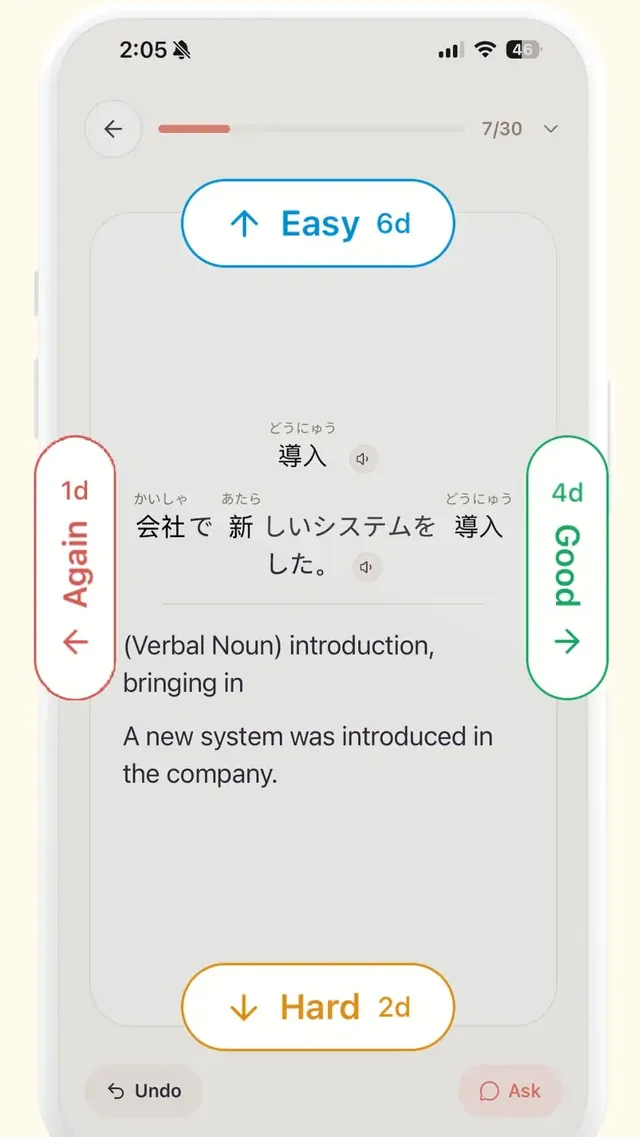
Studying this deck in Decks
After each card you rate it Again, Hard, Good or Easy, and the rating sets when it comes back. Tae Kim's Japanese Grammar has 2,076 cards in the app; this site shows the first 100.
More from Tae Kim's Japanese Grammar
かわいい
This sounds slightly like "kawaisou" instead of "kawaii hito", but the speaker is really saying "kawaii hito".
A cute person! kawaii: cute, adorable This is the second adjective type, the "i"-adjective. They have slightly different properties than "na"-adjectives. For example, they directly describe a noun; "na" is never used with them. You wouldn't say "kawaii na hito". Since they do not act as nouns, you can't add "da" either. So you can say: "taisetsu da" (because taisetsu is a noun + a na-adjective), but not "kawaii da", because kawaii is an i-adjective. The name comes from the fact that these words end on "i".すごい
かわいい もの
Double vowels (ii in this case) are pronounced long.
すごくない
sugokunai: not amazingすごくない
sugokunai: not amazing. Note that this is formulated again as question without question indicator. This is an informal way to ask: "Isn't this amazing?".