Decks

僕 は バカ だ: Tae Kim's Japanese Grammar flashcard

↑ Back to deck← PreviousNext →Random card

僕ぼく は バカ だ

As for me, I am an idiot. 僕[ぼく]は is usually omitted if the topic is clear from context. は is the topic particle and is always pronounced わ. It's attached to a noun and identifies it as the topic of the sentence.

Card 29 of 2,076 in Tae Kim's Japanese Grammar.
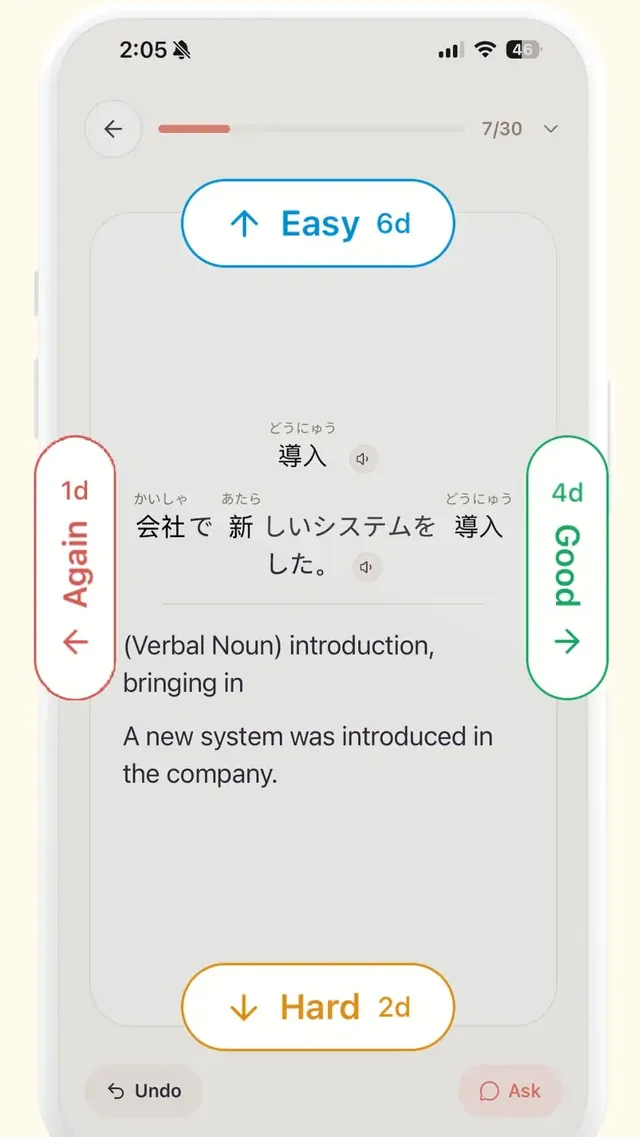
Rating a Japanese card in Decks: Again 1 day, Hard 2 days, Good 4 days, Easy 6 days

Studying this deck in Decks

After each card you rate it Again, Hard, Good or Easy, and the rating sets when it comes back. Tae Kim's Japanese Grammar has 2,076 cards in the app; this site shows the first 100.

Download Decks on the App Store

More from Tae Kim's Japanese Grammar

みんな じゃなかった

[Oh] it was not everybody [who went there last year]?

私わたし は  幸しあわせ だ

As for me, [I am] happy. "ha" (always spelled in Hiragana: は) is the "topic particle" and is always pronounced "wa". It's attached to a noun and identifies it as the topic of what you're talking about or as topic of the sentence. Together with "shiawase da", this may now make more sense. You could translate "watashi ha shiawase da" as: "As for me, I'm happy". It's very important to keep in mind that "watashi ha" is almost certainly omitted, if it's clear that it is YOU who's being talked about. So if someone asks you, how you're feeling, you'd rather say: shiawase da, but not watashi ha shiawase da.

私わたし は エイティーン だ

The “ー” prolongs the “i”. It's an artifact from katakana, a separate Japanese alphabet.

As for me, [I am] eighteen. "eithi-n" sounds familiar? It's the English "eighteen" adapted to Japanese. You find these kind of things very often in anime. However, many common Japanese words are directly adapted from English (and other languages) into Japanese. These words are always written in Katakana. "ha" (always spelled in Hiragana: は) is the "topic particle" and is always pronounced "wa". It's attached to a noun and identifies it as the topic of what you're talking about or as topic of the sentence. It's very important to keep in mind that "watashi ha" is almost certainly omitted, if it's clear that it is YOU who's being talked about.

僕ぼく は  男おとこ だ

As for me, [I'm] a guy. otoko: man; male "ha" (always spelled in Hiragana: は) is the "topic particle" and is always pronounced "wa". It's attached to a noun and identifies it as the topic of what you're talking about or as topic of the sentence. It's very important to keep in mind that "boku ha..." is most certainly omitted, if the topic is clear from context.

今日きょう は ありがとう

Note the long pronunciation of the "o"s.
They result from yo/よ + u/う and to/と + u/う in this case.

As for today - thank you (or less literal: Thank you for today). kyou: today "ha" marks "kyou" as the topic you're talking about. Imagine someone did something big for you today. Just saying "thank you" may not make clear what you're thanking for, so adding "kyou ha" makes sense here. It points out that you're thanking for what happened throughout the day. "ha" (always spelled in Hiragana: は) is the "topic particle" and is always pronounced "wa". It's attached to a noun and identifies it as the topic of what you're talking about or as topic of the sentence. It's very important to keep in mind the entire "xxx ha..." is usually omitted, if the topic is clear from context.

今日きょう は ごめん

As for today [what happened today]: sorry! "ha" (always spelled in Hiragana: は) is the "topic particle" and is always pronounced "wa". It's attached to a noun and identifies it as the topic of what you're talking about or as topic of the sentence. It's very important to keep in mind the entire "xxx ha..." is usually omitted, if the topic is clear from context.