Decks

今日 は ごめん: Tae Kim's Japanese Grammar flashcard

↑ Back to deck← PreviousNext →Random card

今日きょう は ごめん

As for today [what happened today]: sorry! "ha" (always spelled in Hiragana: は) is the "topic particle" and is always pronounced "wa". It's attached to a noun and identifies it as the topic of what you're talking about or as topic of the sentence. It's very important to keep in mind the entire "xxx ha..." is usually omitted, if the topic is clear from context.

Card 32 of 2,076 in Tae Kim's Japanese Grammar.
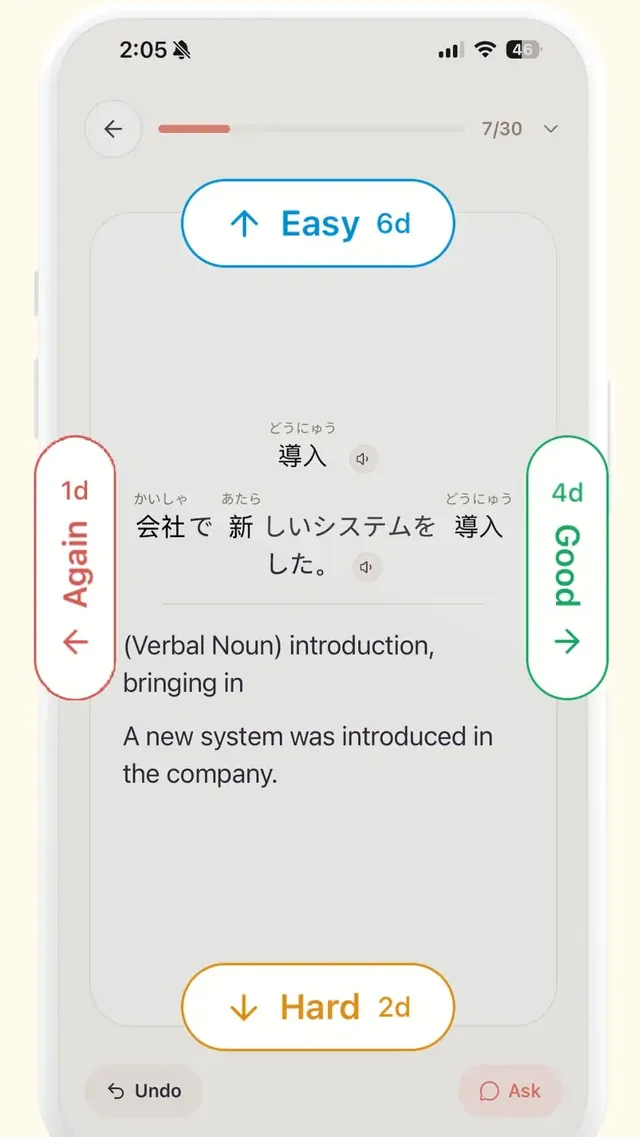
Rating a Japanese card in Decks: Again 1 day, Hard 2 days, Good 4 days, Easy 6 days

Studying this deck in Decks

After each card you rate it Again, Hard, Good or Easy, and the rating sets when it comes back. Tae Kim's Japanese Grammar has 2,076 cards in the app; this site shows the first 100.

Download Decks on the App Store

More from Tae Kim's Japanese Grammar

僕ぼく は バカ だ

As for me, I am an idiot. 僕[ぼく]は is usually omitted if the topic is clear from context. は is the topic particle and is always pronounced わ. It's attached to a noun and identifies it as the topic of the sentence.

僕ぼく は  男おとこ だ

As for me, [I'm] a guy. otoko: man; male "ha" (always spelled in Hiragana: は) is the "topic particle" and is always pronounced "wa". It's attached to a noun and identifies it as the topic of what you're talking about or as topic of the sentence. It's very important to keep in mind that "boku ha..." is most certainly omitted, if the topic is clear from context.

今日きょう は ありがとう

Note the long pronunciation of the "o"s.
They result from yo/よ + u/う and to/と + u/う in this case.

As for today - thank you (or less literal: Thank you for today). kyou: today "ha" marks "kyou" as the topic you're talking about. Imagine someone did something big for you today. Just saying "thank you" may not make clear what you're thanking for, so adding "kyou ha" makes sense here. It points out that you're thanking for what happened throughout the day. "ha" (always spelled in Hiragana: は) is the "topic particle" and is always pronounced "wa". It's attached to a noun and identifies it as the topic of what you're talking about or as topic of the sentence. It's very important to keep in mind the entire "xxx ha..." is usually omitted, if the topic is clear from context.

僕ぼく も

Me (male) too.

みんな も

The others [go there] too. Again: Everything written in [] is clear from context.

私わたし も

Me too.