 Decks
Korean alphabet (Hangul) chart: all 40 letters with pronunciation
Hangul, the Korean alphabet, has 24 basic letters: 14 consonants and 10 vowels. Five doubled consonants and 11 combined vowels are written with them, which makes 40 letters in all, 19 consonants and 21 vowels. These are all 40, from the Hangul deck. Each row gives the romanization, the consonant's name or how the vowel is written on its own, and the sound in IPA.
Printable chart: download the PDF (one US Letter page with all 40 letters, their romanization, names and IPA) or the PNG image.
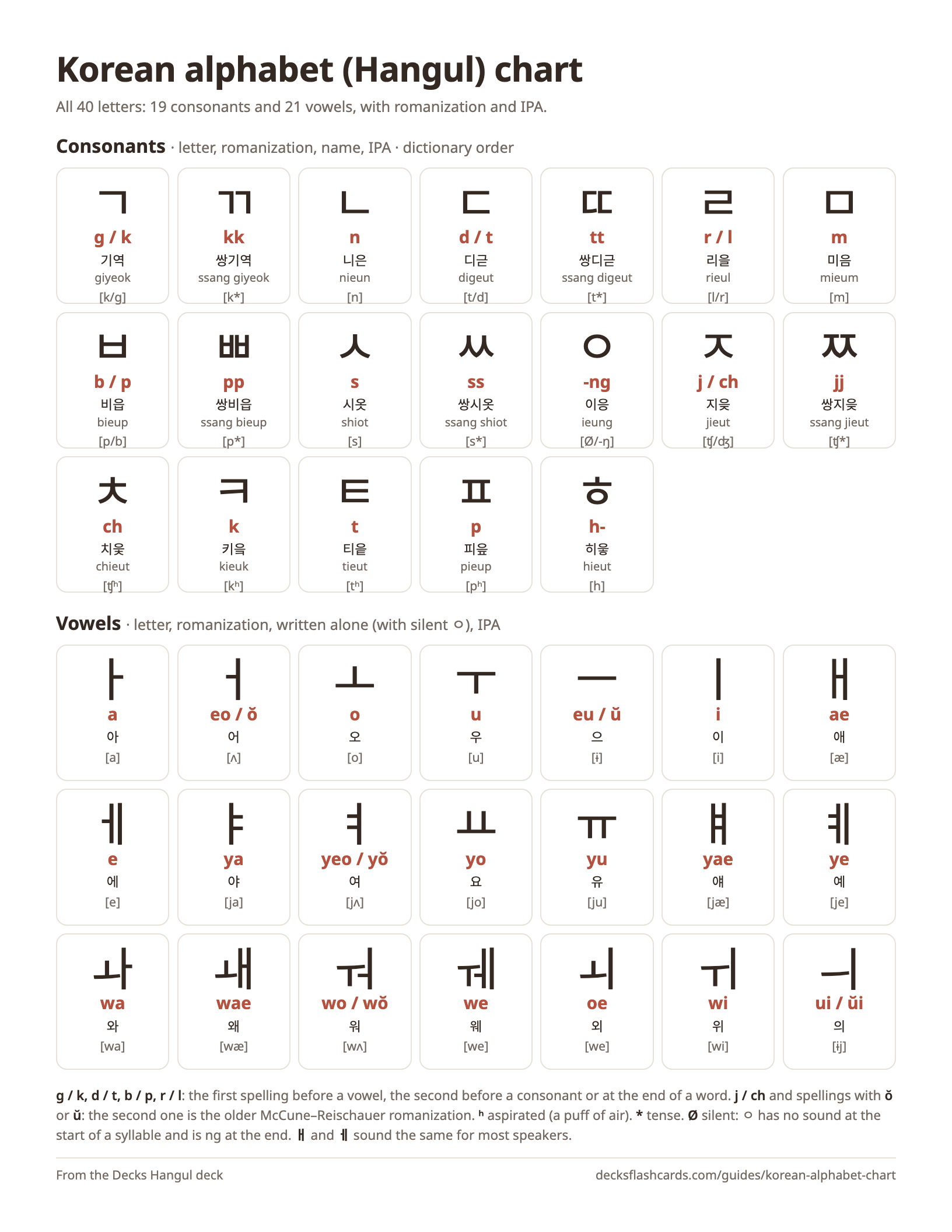
| # | Letter | Sound and name |
|---|---|---|
| 1 | ㄱ | g / k Name: 기역 (giyeok) IPA: [k/g] |
| 2 | ㄲ | kk Name: 쌍기역 (ssang giyeok) IPA: [k*] |
| 3 | ㄴ | n Name: 니은 (nieun) IPA: [n] |
| 4 | ㄷ | d / t Name: 디귿 (digeut) IPA: [t/d] |
| 5 | ㄸ | tt Name: 쌍디귿 (ssang digeut) IPA: [t*] |
| 6 | ㄹ | r / l Name: 리을 (rieul) IPA: [l/r] |
| 7 | ㅁ | m Name: 미음 (mieum) IPA: [m] |
| 8 | ㅂ | b / p Name: 비읍 (bieup) IPA: [p/b] |
| 9 | ㅃ | pp Name: 쌍비읍 (ssang bieup) IPA: [p*] |
| 10 | ㅅ | s Name: 시옷 (shiot) IPA: [s] |
| 11 | ㅆ | ss Name: 쌍시옷 (ssang shiot) IPA: [s*] |
| 12 | ㅇ | -ng Name: 이응 (ieung) IPA: [Ø/-ŋ] |
| 13 | ㅈ | j / ch Name: 지읒 (jieut) IPA: [ʧ/ʤ] |
| 14 | ㅉ | jj Name: 쌍지읒 (ssang jieut) IPA: [ʧ*] |
| 15 | ㅊ | ch Name: 치읓 (chieut) IPA: [ʧʰ] |
| 16 | ㅋ | k Name: 키읔 (kieuk) IPA: [kʰ] |
| 17 | ㅌ | t Name: 티읕 (tieut) IPA: [tʰ] |
| 18 | ㅍ | p Name: 피읖 (pieup) IPA: [pʰ] |
| 19 | ㅎ | h- Name: 히읗 (hieut) IPA: [h] |
| 20 | ㅏ | a Written alone: 아 IPA: [a] |
| 21 | ㅓ | eo / ŏ Written alone: 어 IPA: [ʌ] |
| 22 | ㅗ | o Written alone: 오 IPA: [o] |
| 23 | ㅜ | u Written alone: 우 IPA: [u] |
| 24 | ㅡ | eu / ŭ Written alone: 으 IPA: [ɨ] |
| 25 | ㅣ | i Written alone: 이 IPA: [i] |
| 26 | ㅐ | ae Written alone: 애 IPA: [æ] |
| 27 | ㅔ | e Written alone: 에 IPA: [e] |
| 28 | ㅑ | ya Written alone: 야 IPA: [ja] |
| 29 | ㅕ | yeo / yŏ Written alone: 여 IPA: [jʌ] |
| 30 | ㅛ | yo Written alone: 요 IPA: [jo] |
| 31 | ㅠ | yu Written alone: 유 IPA: [ju] |
| 32 | ㅒ | yae Written alone: 얘 IPA: [jæ] |
| 33 | ㅖ | ye Written alone: 예 IPA: [je] |
| 34 | ㅘ | wa Written alone: 와 IPA: [wa] |
| 35 | ㅙ | wae Written alone: 왜 IPA: [wæ] |
| 36 | ㅝ | wo / wŏ Written alone: 워 IPA: [wʌ] |
| 37 | ㅞ | we Written alone: 웨 IPA: [we] |
| 38 | ㅚ | oe Written alone: 외 IPA: [we] |
| 39 | ㅟ | wi Written alone: 위 IPA: [wi] |
| 40 | ㅢ | ui / ŭi Written alone: 의 IPA: [ɨj] |
How the chart is organised
The consonants are in the order Korean dictionaries use: ㄱ ㄲ ㄴ ㄷ ㄸ ㄹ ㅁ ㅂ ㅃ ㅅ ㅆ ㅇ ㅈ ㅉ ㅊ ㅋ ㅌ ㅍ ㅎ. The vowels are grouped for learning instead: the six simple vowels (ㅏ ㅓ ㅗ ㅜ ㅡ ㅣ), then ㅐ and ㅔ, then the vowels that start with a y sound (ㅑ ㅕ ㅛ ㅠ ㅒ ㅖ), then the ones that start with a w sound (ㅘ ㅙ ㅝ ㅞ ㅚ ㅟ), and ㅢ last. A dictionary puts each combined vowel next to its base instead: ㅏ ㅐ ㅑ ㅒ ㅓ ㅔ and so on.
The letter counts, the names and the dictionary order come from the National Institute of Korean Language's spelling rules (Hangul Matchumbeop, Article 4).
The consonants
- Three of each stop. ㄱ ㄷ ㅂ ㅈ are plain. ㅋ ㅌ ㅍ ㅊ are the same sounds with a puff of air (aspirated, marked ʰ in the IPA column). ㄲ ㄸ ㅃ ㅉ, and ㅆ beside ㅅ, are the tense versions (marked *). English has no tense series, and romanization can't show the difference well, so learn these three sets by ear.
- g or k, d or t, b or p. Korea's official Revised Romanization writes ㄱ ㄷ ㅂ as g, d, b before a vowel and as k, t, p before a consonant or at the end of a word: 구미 Gumi, 합덕 Hapdeok. ㄹ is r before a vowel and l before a consonant or at the end: 설악 Seorak, 임실 Imsil.
- ㅇ is silent at the start of a syllable and sounds ng at the end. A written syllable always starts with a consonant letter, so ㅇ fills that slot when the syllable starts with a vowel sound: 아 is ㅇ + ㅏ and is said a.
- Only seven sounds at the end of a syllable. A final consonant is said as one of ㄱ ㄴ ㄷ ㄹ ㅁ ㅂ ㅇ. ㅋ and ㄲ there sound like ㄱ; ㅅ ㅆ ㅈ ㅊ ㅌ sound like ㄷ; ㅍ sounds like ㅂ. So 옷 (clothes) is said 옫, and 앞 (front) is said 압 (Standard Pronunciation rules, Articles 8 and 9).
The vowels
- Built from lines. Every vowel uses a long vertical line, a long horizontal line, or both, with short strokes added. ㅏ a and ㅓ eo point opposite ways, as do ㅗ o and ㅜ u. A second short stroke adds a y sound: ㅏ a becomes ㅑ ya, and ㅗ o becomes ㅛ yo.
- ㅐ and ㅔ sound the same for most speakers. The National Institute of Korean Language's commentary on the standard pronunciation says most generations no longer tell them apart, though the standard still counts them as two vowels. You learn which one a word uses from its spelling.
- ㅚ can be said like ㅞ. The standard allows ㅚ as a single vowel or as we, the same as ㅞ. Both rows in the chart show [we].
- ㅢ changes with position. After a consonant it's said like ㅣ: 희망 (hope) is said 히망. In later syllables of a word it may also be said ㅣ, and as the particle 의 ("of") it may be said 에. The romanization stays ui either way.
How letters make syllables
Korean is written in syllable blocks, not in a row of separate letters. Each block has a consonant and a vowel, and some have a final consonant at the bottom (called batchim).
- A vowel built on a vertical line (ㅏ ㅓ ㅣ ㅐ and the rest) goes to the right of the consonant: ㄱ + ㅏ = 가 ga.
- A vowel built on a horizontal line (ㅗ ㅜ ㅡ ㅛ ㅠ) goes underneath: ㄱ + ㅗ = 고 go.
- A final consonant goes at the bottom of the block: 가 + ㄱ = 각 gak.
The word 한글 (Hangul) is two blocks: ㅎ ㅏ ㄴ and ㄱ ㅡ ㄹ.
How to learn Hangul with flashcards
- About 8 new letters a day. At that pace all 40 are done in 5 days, which is the first week of the plan for your first 500 Korean words. Each new card brings reviews over the following weeks; new cards per day shows how a daily number turns into a review load.
- Play the audio every time. Each card has a native speaker recording. It's the only reliable way to hear ㄱ, ㅋ and ㄲ as three different sounds.
- Hold back a look-alike. If two letters keep getting mixed up, such as ㅓ and ㅗ, suspend one until the other is solid, then bring it back. Fixing a card you keep forgetting explains how.
- Move on to words soon. Once you recognise most letters, reading real words is the best practice. Korean First 500 Words has audio for every word, so you can check each one as you sound it out.
Published 2026-11-20. Updated 2026-11-22.